The PB-3000 R|Evolution is SVS's best-selling ported subwoofer, rebuilt, and it's the one I'd buy for PB-17 territory without PB-17 size, weight, or price. The original PB-3000 was already my personal favorite. The R|Evolution keeps what made it special and adds a new 13" high-excursion driver, 1,200 watts RMS (50% more than the original, on par with the PB-4000), balanced XLR inputs, and a vented amp. The result is composure at volume: explosive when the scene calls for it, and refined about how it gets there. It's THAT good.
It's still ported, on purpose, and still 85 pounds. Two of them, placed right, will outperform ANY single subwoofer, even at twice the price. One alone gives you Swiss Cheese Bass. If you can only afford one, buy a matched pair of PB-1000 Pro's or PB-2000 Pro's instead. Below: what actually changed, who it's for, and the four Bass Hacks I use to set up ANY subwoofer.
SVS sent me the PB-3000 R|Evolution to review. I've run the original PB-3000 for years, the best-selling ported subwoofer SVS has ever made, and it was already my personal favorite regardless.
This is the upgraded version. It's more solid, with updates that make real sense, rather than fluff for the sake of being "new."
I won't hand out praise to gear that doesn't earn it, and I don't get excited about an "update" just because a manufacturer slaps a new name on the box.
Why It's Been My Favorite
Back in 2018 when the PB-3000 first came out, it was a problem for SVS: eyes closed, it was nearly impossible to tell it apart from the PB-4000. It was disruptive, and a lot of that can be attributed to the split wind voice coil.
It "put a little more stank on it" for high-impact scenes, which is the whole reason you'd upgrade from a PB-1000 Pro or PB-2000 Pro: realism, impact, explosiveness. It hits deeper in the chest, at the same relative volume.
Sure, it can GO louder, but unless your current sub can’t play as loud as you want, you probably aren’t going to listen much louder than you already do when coming from PB-1000 Pro’s.
You're buying more potency. "Dynamic Headroom" is the technical term, but most people aren't going to know what that means off the bat.
The split wind voice coil made it sound like a more powerful subwoofer than it was. SVS refined that coil even further.
Size and Weight
It was only 1 inch bigger in every dimension than the PB-2000 Pro, so it's easier to move than the PB-4000, about half the weight, and considerably smaller overall.
I move subwoofers around more than the average user. This is still a large subwoofer, but moving the PB-3000 is FAR less of an ordeal.
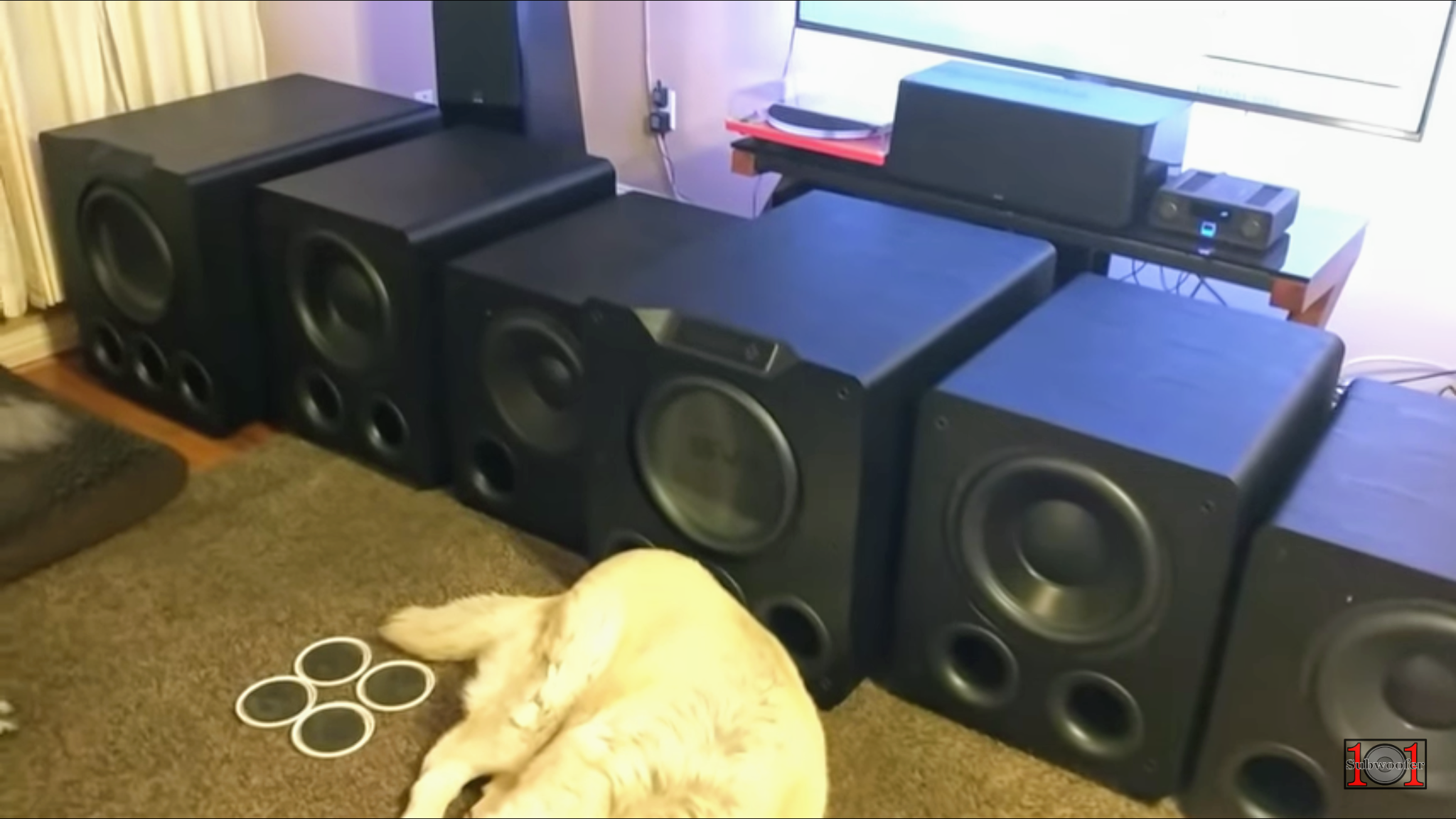
Left to right, PB-4000, PB-3000 original, PB-2000 original (Same dimensions as the Pro), and the PB-4000 again, PB-3000 original, PB-2000 original. PB-4000 = 153.2 pounds, PB-3000 = 82.2 pounds.
That's part of what made it special in the first place: it was almost indistinguishable from the next step up in the SVS line at the time, more affordable, more manageable, and with a better shot at passing what I call the Partner Acceptance Factor.
Partner Acceptance Factor
I say Partner Acceptance Factor rather than Wife Acceptance Factor, because plenty of situations don't fit that traditional framing, and living situations span the gamut.
It's not just married people who care about how a subwoofer looks in a mixed-use room, which is what most people are actually working with, rather than a dedicated theater space.
I really liked the old metal grille a lot, but the new grille stands out less and takes up a smaller footprint. I understand the decision. It's more likely to be accepted.
How You Know It's THAT Good
Whether someone has any interest in audio or not, people generally recognize when they're hearing something unusual. It's self-evident.
I've shown several husbands what a deep bass system can do, and even with his wife in another room, I'll hear "No, we're not getting one, don't even think about it," completely unprompted.
Nobody asked. Nothing at all was said. It's not that it sounded bad. It sounded too good, and it sounded more expensive than it was.
A Straight-Shooting Critic
In my experience, some of the most useful feedback comes from people with zero stake in audio gear, and no interest in the jargon. It's easy to impress a 20-year-old guy: crank it up, job done.
It's harder to impress someone who isn't inclined to be impressed by volume alone, and who's judging the sound on their own terms.
My new mother-in-law is a straight shooter. If it's too much bass, she'll say so. If it grates on her ears, she'll say so. There's no reason for her to hold back, and no bias pulling her one way or the other.
I set up a system for her as a Christmas gift for my father-in-law: dual PB-1000 Pro’s, four SVS Prime Satellites, a Prime Center, all powered by a Denon X3800. A simple 5.2 setup with room to grow. He was thrilled.
What genuinely meant the most to me was the text my wife got afterward: "OK, I get it, Ryan clearly knows what he's doing."
She's been enjoying Santana and the rest of her favorite music in a new way for almost two years now. I’m actually working on this article in her living room while everyone is enjoying a movie.
My own mother passed in 2021 in her early 70s, and losing her led to a real break in my production for a while.
Having my mother-in-law in my life since then has meant a lot. I just wish they'd had the chance to meet, because my mom had that same call-it-as-she-sees-it streak, always kind about it, and usually a little funny.
An Unsolicited, Hilarious Review
She had some of my old gear set up at her house, and I asked to borrow the Bose 301's to compare against the Prime Satellites, leaving her a set of SVS Satellites in the meantime. She used them daily, with an old AVR running 5.1, it sounded better than the TV speaker.
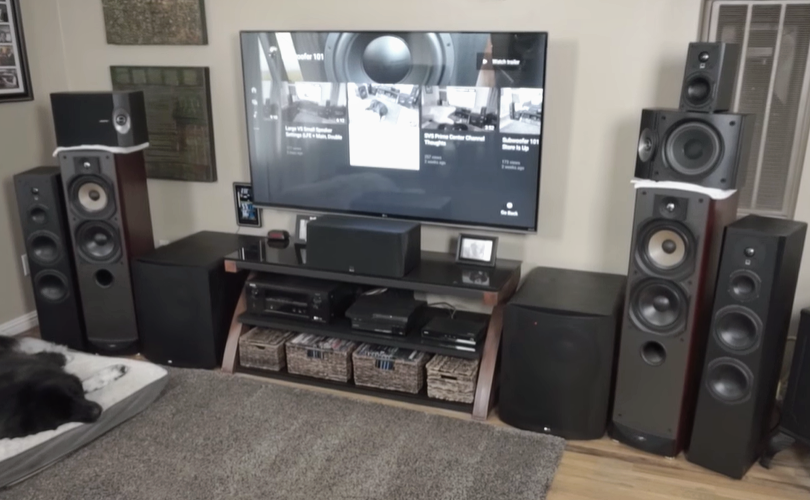
SVS Prime Satellite vs Bose 301 Series IV comparison video screenshot.
When I brought the 301's back, without any prompting, she told me the difference was substantial. Her exact words: "Yeah, the Bose are pretty skanky, aren't they?" I laughed hard for several minutes!
I'd never heard that word applied to audio before. Probably not my choice of words, but that was her opinion regardless.
I wasn't fishing for a review from my 70-year-old mother. But I sure got one, and she had every reason to prefer "her speakers," and the bigger, better-known name. She just didn't.
"It Just Looked Too Loud"
My favorite story: whenever she came by, I'd offer to play the system for her, and she'd flatly refuse. HARD NO. Multiple times. I eventually realized it probably just “looked loud”, which is fair.
Men have a habit of trying to impress people with their systems by cranking everything to the moon, turning what could sound great into something punishing and grating. I've sat through enough of those system demos myself to know it's a legit problem.
Guys, if you want to impress someone, go for quality over loudness. A factory Ford Pinto stereo can get loud too. It doesn't mean it sounds good.
My mom was a real music fan, and her favorite artist was Anne Murray, so I built her a Spotify playlist (still up on my profile) and devised a plan.
The Tipping Point and Resulting Addiction
I sat her in my chair and said: "Mom, you have full control of the volume. I'm only asking for 15 seconds. If you can't handle that, we stop." Reluctantly, she agreed, with that familiar look that said "you'd better not make me regret this."
"You Needed Me" was up first, with a heavy, full, rich bass line. Surprising for the genre.
We made it WELL past 15 seconds.
We got through a chunk of her playlist before she had to leave. "Broken Hearted Me" on the system was the first time she could clearly hear the difference in the changing bass guitar notes.
After that day, every visit came with a request to hear the system.
For Thanksgiving and her birthday, she wanted the Eagles Blu-ray concert playing during dinner. She told a friend she went to my house for an Eagles concert on her birthday.
The subwoofers doing this miracle work were the original PB-3000's.
One Level for Music and Movies
Once she trusted that her eardrums weren't in danger, I played the driveway gunfight scene from "The Accountant," the suppressed-fire moment where the subwoofer punches out one single gunshot around 23 Hz. It's my reference track for how explosive a subwoofer really is.
It wasn't her favorite. She jumped in her seat, although her ears weren’t harmed as promised.
But she WAS impressed, and I hadn't touched the levels between that, and her Anne Murray playlist. Properly adjusted, I don't find a reason to change anything between music and movies. Proper tends to be proper, across the board.
The Two-Channel Music Case
The PB-3000 R|Evolution delivers the kind of bottomless musical support that two-channel enthusiasts probably imagine when they're eyeing a $200,000 pair of speakers. “Big, Expensive Sound”, whatever that might be.
Many people chase "Big Sound" by emptying their wallets on massive loudspeakers that still fall short on the bottom end. Most are looking in the wrong place. The better the bass, the bigger the sound feels, even at the same volume, and even with relatively small speakers.
As absurd as it sounds, if your $200,000 tower speakers can’t hit the deepest notes with gusto, (they probably don’t) a simple $4,000 system with deep bass subs can sound “bigger” and more satisfying.
In the two-channel world, ported subwoofers get treated like a compromise, or even as a foolish newbie “mistake”. Everything's supposed to be sealed, because ported subs have a reputation for being loose and sloppy. Unrefined.
To be fair, most single ported subs are.
Matched, deep bass dual subs are a different story entirely; clean and tight enough to handle that “Accountant” scene, one cycle from a dead stop, without falling apart. If a subwoofer can do that cleanly without breaking a sweat, pipe organ and upright bass are NOTHING by comparison.
Why Ported, and Why It Stays That Way
I usually can't tolerate sealed subwoofers for more than half an hour. They cause a pressure sensation in my ears, mild but real, and part of that traces back to an old head injury that left me more sound-sensitive (fragile) than most people.
Post Concussion Syndrome makes it worse for me specifically, but the pressure itself isn't unique to me. It's a real issue for plenty of people regardless of the cause.
SVS sells sealed subs two to one over ported, and I’m sure they'd love for me to recommend sealed subs across the board. I don't.
The discomfort is real for enough people, and sealed subs don't have the same depth of presentation (deep sound) as a ported cabinet. You can EQ a sealed sub in the app to emulate ported behavior, and it helps. It's still not quite the same.
The ported SVS cabinets can be switched to sealed anytime with the included plugs and a simple change in the App.
A sealed cabinet can never go the other direction. If you're not sure which you'll prefer, ported is the easy choice; try it sealed first if you want, but most people land back on ported.
It’s definitely NOT because it sounds worse.
My Sealed-Sub Workaround
I've actually gotten to where I can tolerate sealed subs quite well now, by staggering the timing slightly, adding one to two extra feet of distance to just one subwoofer in the AVR settings.
With my usual distance hack (more on that below), if both subs register at 12 ft post-room correction, I'll add 4 ft to one and 6 ft to the other: 16 ft and 18 ft. It doesn't matter which side gets the extra 2 ft.
That slight shift makes the constructive interference just imperfect enough for me to tolerate, with zero ear pressure.
With ported subs, I don't need that workaround in the first place.
The timing stays perfect, no stagger, no compromise. Constructive interference is what resolves the standing-wave effect that robs you of bass with a single subwoofer, more on that below too.
What the R|Evolution Actually Changes
New 13" high-excursion driver. The engineering is solid, but what matters is what it does: it keeps the sub composed at volume, using the split wind voice coil to sound like it has even more power than it does.
Composure is what separates a sub that gets sloppy at high volume from one that just handles it, and these subs handle it effortlessly.
There's something else I noticed, though I'll admit I doubt my own read on it, since it’s so subtle that it could be my imagination.
On the previous version, there seemed to be more of a defined step between low-energy and high-energy passages, almost a line where the split wind design boost kicked in, and you could feel it engage.
On the R|Evolution, that transition feels more linear, more refined, with a much less noticeable line between the two states. It's smooth enough that I didn't consciously register it happening at all.
I just noticed, after the fact, that I hadn't noticed it.
There's a stronger amp platform now too, with balanced XLR inputs on the 3000 series for the first time, so it's compatible if your gear runs balanced cables. The amp is also vented now. Neither version runs hot, but it's cheap insurance for thermal management and longevity down the road.
SVS doesn't change things for the sake of posterity. Having worked with them for over a decade, I can say there's always a reason behind what they do. They weren't going to touch their best-selling ported subwoofer unless the improvement was real.
The Specs, and Why I Don't Lead With Them
I'm not going to quote wattage numbers as though they tell you how deep or how good a sub sounds. Specs don't confirm anything, so much as they filter out bad performers.
A quick beginner friendly note: If you aren’t sure what sound frequency is all about, shallow bass that gives out at a higher frequency around 150-200 hertz is like what your laptop or cell phone are limited to, where 20 hertz is about as low as you can hear, like thunder in real life.
Play the sound of thunder on your laptop or cell phone, and you aren’t going to mistake it for being real.
If the bass is correct in a home theater system, it will sound a LOT more like real life. Convincing. Immersive. Powerful. Moving.
A subwoofer frequency response rating above 25 Hz on a spec sheet is usually a sign to look elsewhere, but it's not a “confirming” number.
Twenty different subs can share the same factory-rated 17 Hz response, and still sound drastically different in depth of presentation, or how deep it sounds.
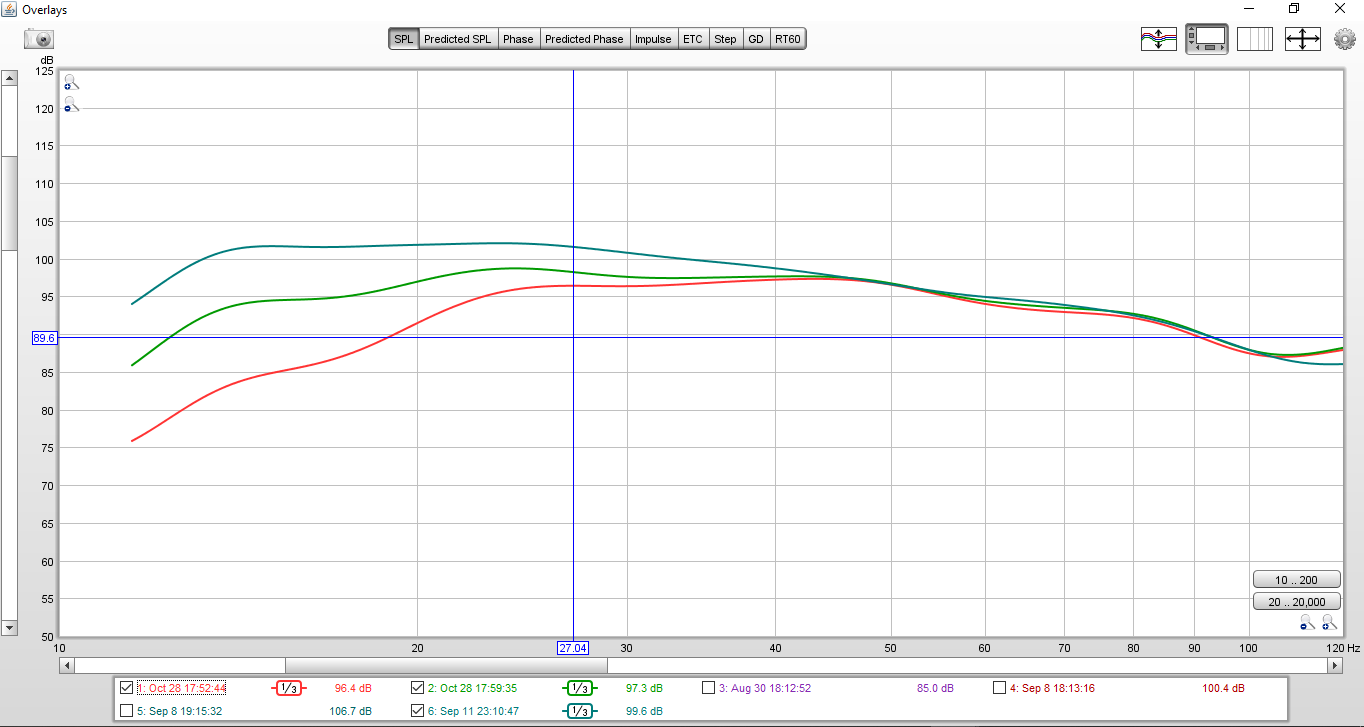
This is a subwoofer at different settings, but this could just as easily be 3 different subwoofers rated around 17 hertz. The real world difference in how deep it sounds is dramatic.
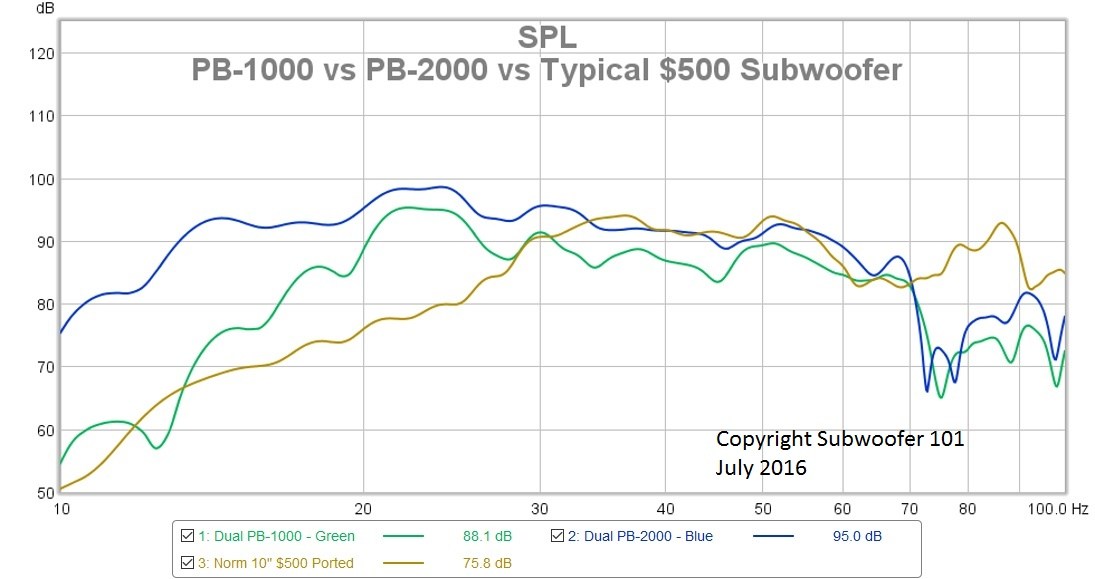
“Normal $500 sub” was rated at 30 hertz, but started to trail off around 35 hz.
A sub rated at 30 Hz is basically guaranteed to be shallow. I haven't found an exception, so I don't bother; it's already told me what it is. Shallow. Weak. Anemic.
Still, worth noting on the PB-3000 R|Evolution specs: 1,200 watts RMS, 50% more power than the original, and on par with the PB-4000. It's not small either, 85 lbs, 21.9” tall, 18.3” wide, and 26” deep.
Plan your space before you order a pair.
A Single Subwoofer Is a Common, Expensive Mistake
I say this in nearly every piece of content I make about this hobby: a single subwoofer, no matter how good, gives you “Swiss Cheese Bass”.
Too loud in one spot, and dead in another, and which frequencies go dead shifts throughout the room. Seat one might run 72 Hz hot and 45 Hz dead; seat two, 63 Hz hot and 51 Hz dead.
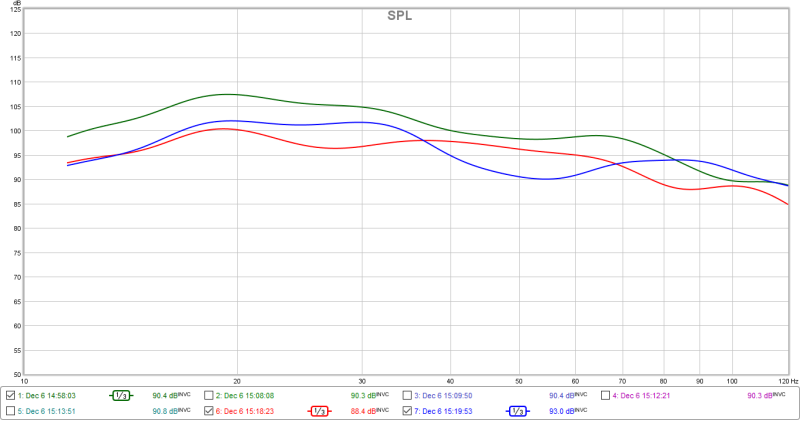
Measured response in the same seat. Red is right only, Blue is left only, and Green is both subs (PB-17’s in this case). The dips and peaks change with location, and are largely straightened out with dual subs. The graph is smoothed to see the trend easier.
Room correction is playing "boom boom whack-a-mole" trying to tame loud spots, but it can only do it from one position, and you cannot truly boost a dead spot.
Subwoofer levels can increase at a dead spot frequency like 59 hertz, but the dead spot stays dead, while other seats (and your neighbors) hear it a little too well.
NO SWEET SPOT WITH A SINGLE SUBWOOFER.
Two matching subs is the real sweet spot. Beyond two, you smooth the room out a little more, but you might trade some gain to keep things balanced, and gain usually contributes to perceived explosiveness. Two PB-3000 R|Evolutions, placed right, will outperform any single subwoofer, even at twice the price. Four PB-2000 Pro's will not be as explosive as two PB-3000’s.
More than two subs increases output and smoothness, but the explosiveness is predetermined by the subwoofer’s explosiveness potential.
Don't Mix Mismatched Subs, Pretty Please?
I never pair mismatched subs. Put a weak one next to a strong one, and the weak one drags the whole system down, the same way a cheap boat oar paired with a carbon-fiber one doesn't average out to "half decent."
You get the weaker of the two, from both.
Similar logic with tires: if one side has poor traction and the other's an ultra-high-performance tire, you're limited by the worse one. Your subs are essentially gripping the air instead of the road, that's essentially what subs are doing, exciting the air.
Placement: Corner Loading Isn't Automatically Right
Corner loading has long been considered one of the "best" spots for a subwoofer, and there's real physics behind it: boundary gain.
Put your head near a wall or in a corner and, depending on the room, the bass gets heavier. You'll generally get more output from a corner than from mid-wall placement.
But in my current theater, when running a pair of PB-17 Ultras, corner loading actually took away from the impact I felt, compared to placing them just inboard of my left and right channels.
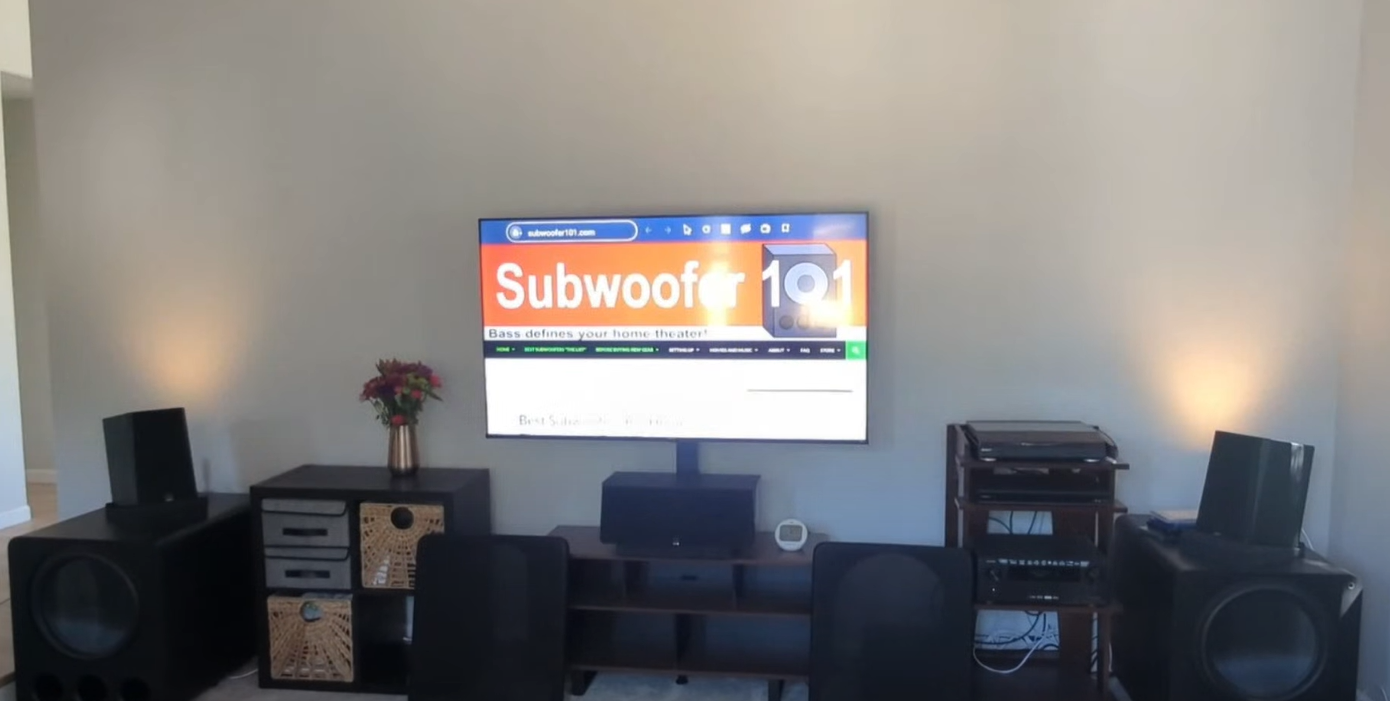
Corner loaded, missing some of the punch.
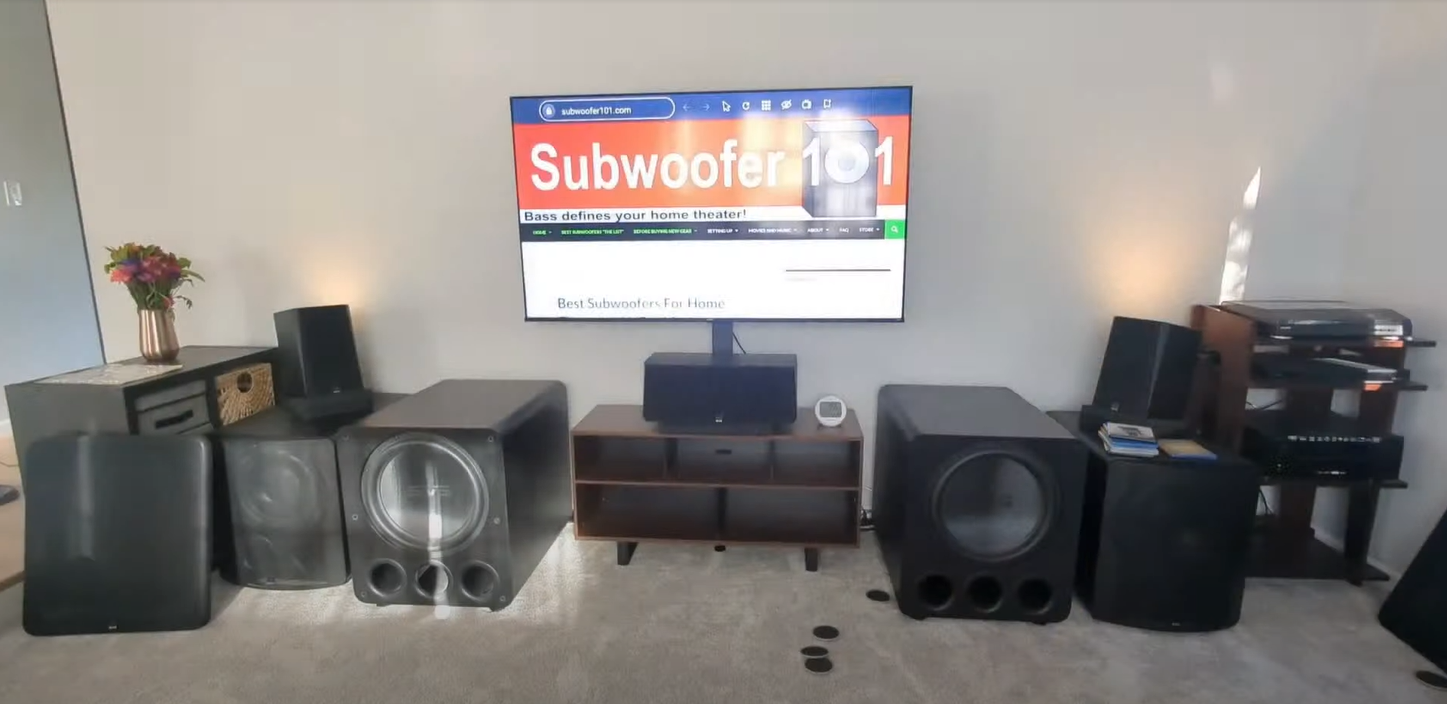
PB-17’s inboard, razor sharp explosiveness and precision returned. I didn’t expect that. Inactive PB-3000’s next to them for size comparison. I never mix subs.
Think of it like a big punching bag. You're hitting it with both fists, same force. Which moves the bag more: your fists a foot apart, or three feet apart?
You still want separation, that's what smooths the room out and kills Swiss Cheese Bass, but push them too far apart and you start losing impact instead of gaining it.
Corners tend to push your subs about as far apart as they can go in most rooms. That's not automatically a win.
Try corner loading. Try inboard of your mains. Adjust by ear, and trust what you feel in your chest over whatever conventional wisdom says the "correct" spot is.
Setting It Up Right: My Bass Hacks
If the subs aren't dialed in once they're in the room, you're not getting everything you paid for.
These are the four hacks I always use with ANY subwoofer, ported or sealed, SVS or otherwise. I've got full video walkthroughs of each on the channel if you want the deep dive; here's the short version.
Gain Hack. I run a lower AVR subwoofer level, around -11.5 on Denon and Marantz, and raise the gain on the sub itself to compensate. That gives the subwoofer more headroom and a stronger, cleaner punch.
Do it backwards, high AVR subwoofer level and low sub gain, and you'll likely get clipping, where the sub runs out of steam. This is true for any subwoofer, not just SVS.
SVS doesn't recommend going hotter than -6 for regular use (0 is max gain). I rarely go past -9; the PB-3000 R|Evolutions are currently sitting between -10 and -12 depending on my mood.
Distance Hack. This one's measurable and repeatable. It reduces cancellation between your main speakers and your subs.
You'll notice the room correction distance often reads further than the physical distance, because of a small delay from the DSP. A 10 ft sub might register at 12.5 or 14 ft; that's normal.
"Distance" is just an easier way for most people to reconcile timing than "delay" measured in milliseconds would be.
Counterintuitively, even in a small room, I add roughly 4 feet to the post-correction distance value. Without it, the bass feels constrained rather than full.
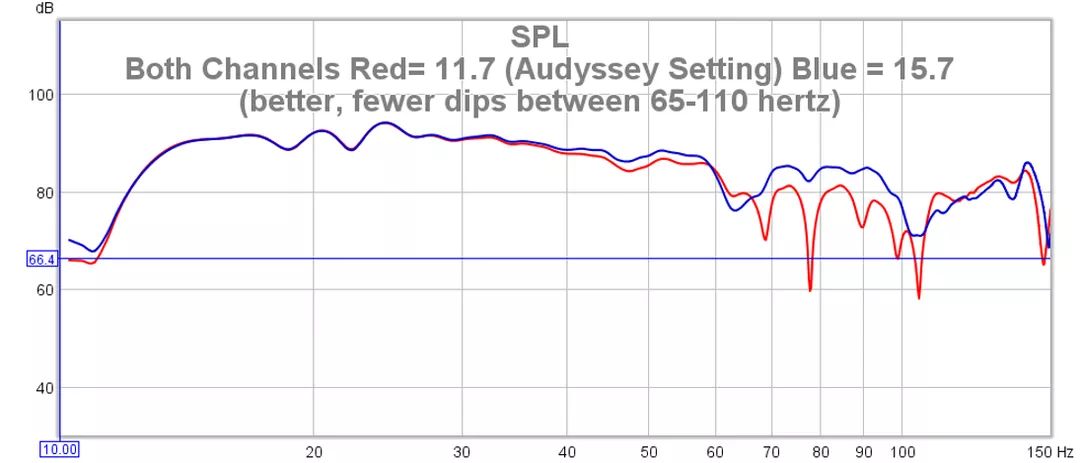
Red line is how room correction sets it, the blue line is 4 feet added to that value.
Room size doesn't change this; it's purely a timing adjustment, getting the bass into the room a few milliseconds sooner to avoid cancellation, since bass has a longer decay than mids and highs anyway.
Crossover Hack. Push your main speaker crossover levels higher in your AVR than you'd think, 80, 90, 120, or even 150 Hz.
That gives the subwoofer more of the content to reproduce while your mains keep playing just as low as before, with less power demand on your AVR.
Your towers already handle the vast majority of the audible signal; let the subs do what they do best. It also makes blending your subs with your mains noticeably easier than a 40 or 60 Hz crossover does.
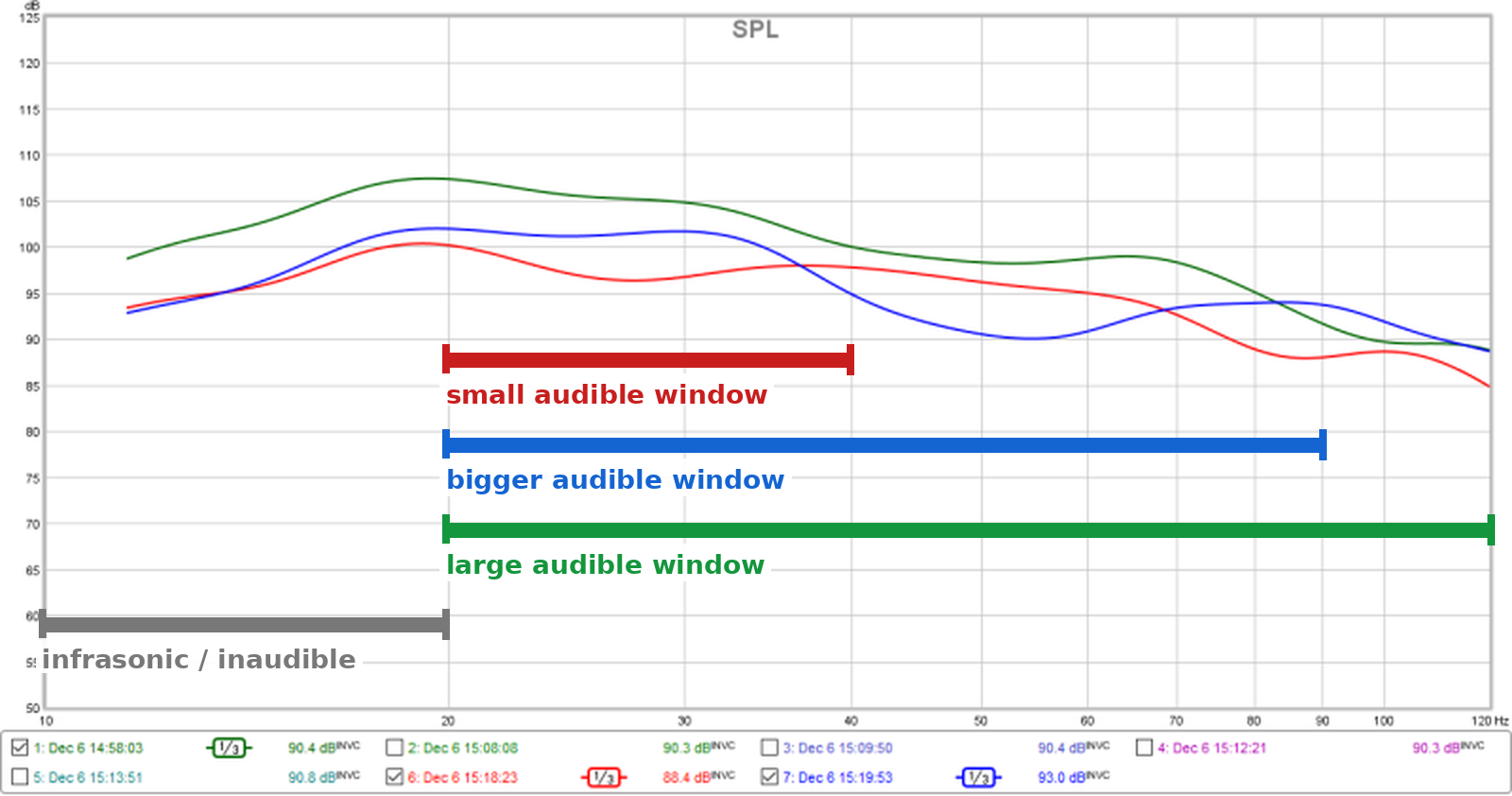
Note: this doesn't work with typical shallow-bass subwoofers; they'll just sound boomy at a higher crossover.
Adjust By Ear. Once the first three are dialed in, trust your ears over any measurement or manufacturer default.
My go-to reference is Metallica's "Murder One," meaty, impactful bass alongside plenty of higher-frequency content.
Push the gain until it's obviously too much, then back it down to just below that point. That'll get you the most output while staying balanced.
Go further than feels comfortable at first, you can run more bass than you'd expect with these subs. Keep in mind your setting will likely shift a bit after a day or two once your ears settle in. Adjust to taste.
Bonus: SVS App Hack. Want to get a little closer to PB-17 territory?
The updated 3000 series app has 6 PEQs instead of 3, but you only need 1 here.
Enable a PEQ at 29 Hz, boost +2 to +4 dB, Q around 2 to 2.5 (higher Q, narrower effect). Match the setting on both subs and try it on the Accountant scene, then on music. Adjust to taste.
One More Setup Note: Use the 12-Volt Trigger
If your AVR supports it, use it instead of relying on auto-on. You get a clean physical click, on with the AVR, off with the AVR, no ambiguity.
Auto-on relies on the subwoofer sensing audio signal, and if you've run the Gain Hack, your AVR level is turned down low enough that auto-sense can struggle to stay locked on. A 12-volt trigger sidesteps that completely.
So Who Is This Sub For?
If you want premium bass that gets you close to PB-5000 or PB-17 territory without the expense, size, or weight, the PB-3000 R|Evolution is about as Goldilocks as it gets.
Genuinely excellent, though I can't call it cheap.
If you can only afford one, you're better off splitting that budget across a matching pair of either PB-1000 Pro's, or PB-2000 Pro's instead.
If you're spending this kind of money on bass, you clearly want real performance, and this is the single most common mistake I see in home theater setups.
A LOT of my other advice doesn't matter much without it. It's genuinely an important step.
Going factory direct (my affiliate links are factory direct) gets you a 1-year trade-up policy, so you can work your way to a pair of PB-3000's, even if it takes a couple of years.
Start with dual PB-1000 Pro's, trade up to dual PB-2000 Pros, the 1 year clock resets, then trade up again. Dual PB-1000 Pros will outperform a single PB-3000, or even a single PB-17 Ultra.
It matters THAT much. Have I made that point yet?
As for the PB-17 Ultra: without question, it's the best bass I've heard. Full stop.
If you've got the budget, the room, and you're not moving subs around regularly like I do, buy once, cry once, and be done with it.
Dual PB-17 Ultras are the only time I've heard a genuinely palpable difference in music quality specifically, not just movies. That surprised me.
Hopefully that gives you a clear picture of what to expect from the PB-3000 R|Evolution, what deep bass should actually feel like, and how to get every last drop of performance out of it by ignoring a little conventional wisdom along the way.
Thanks for stopping by!
Ryan B.
Disclaimer
While I am the first-ever Affiliate for SVS, which took years to develop, I'm not sponsored, nor contractually obligated to say positive things.
If you follow my links, I can potentially earn a commission, which is how I keep the lights on, but it's not a guaranteed revenue source. This review may very well result in zero revenue; that's just how it works with affiliate relationships.
I'm open to all brands, and welcome the chance to review genuine deep-bass subwoofers, but I won't do hit pieces on subs I know I couldn't recommend.
I'll be straight about everything, including the ownership experience as a whole. If a subwoofer is superior to SVS, I'll shout it from the rooftops.
I prefer to diversify, but I refuse to offer false equivalence, some subs simply aren't in the same ballpark, and I respect my audience too much to pretend otherwise.
My affiliate relationships, SVS, Amazon, Monoprice, ABT, Discount Tire/America's Tire, are all potential revenue sources, none of them binding. I chose this path to keep complete editorial freedom and keep my focus where it belongs: with my audience.
SVS has been outstanding from the beginning. Their collective knowledge is second to none, and they've been stand-up people since my very first email.
That said, I haven't promoted their sealed subwoofers, because I'm not going to suggest something I wouldn't choose myself, despite the revenue potential. My bias has been, and always will be, real-world performance.